
 Nolan Martin
 April 29th, 2024
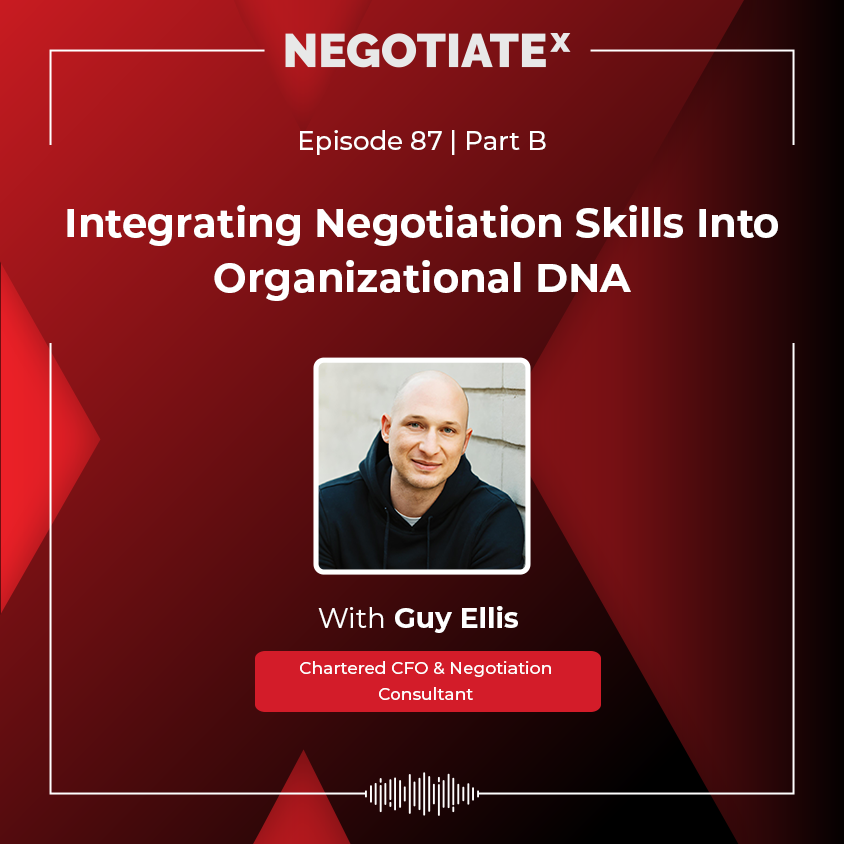
Hey everyone, welcome back to the NEGOTIATEx podcast. We are continuing our conversation with Guy Ellis, a seasoned executive leader, serial entrepreneur, and M&A expert. In Part A, Guy discussed his background in negotiation and the importance of building relationships and trust in negotiations.
He also emphasized the importance of mindset in negotiations, including collaboration, active listening, and reflection. Additionally, Guy explained how negotiation styles may vary across different cultures and the need for preparation and understanding of cultural nuances. If you haven’t checked out Part A, we strongly recommend that you do that first.
With that said, let’s jump right in!
Firstly, Guy discusses the enduring relationships formed from shared experiences, comparing them to connections made during team mountain bike marathons. Despite not speaking to a teammate for a year, their reunion felt as if they had just spoken the week before, illustrating the depth of their connection.
Guy extends this concept to business, where he has experienced people preferring to sell their businesses to him personally due to the trust and rapport built over time. He highlights that both in sports and negotiations, success is not just about immediate results but also about cultivating qualities such as authenticity, kindness, care, grit, skill, and perseverance.
These elements, often recognized in sports, are crucial in negotiations as well, though not always considered.
Guy dives into the complexities of negotiation within the nonprofit sector, specifically focusing on wildlife conservation efforts in Africa. He highlights the primary challenge as aligning the diverse goals and needs of various stakeholders involved, such as communities, funding recipients, scientists, donors, and volunteers. This complexity stems from the need to understand and integrate the differing needs of these groups, which requires significant effort and is foundational to successful nonprofit operations.
Guy emphasizes that effective strategies to navigate these challenges include fostering transparent communication to maintain trust and prevent misinformation, as well as promoting education and awareness among all parties involved. It involves not only educating the beneficiaries but also enlightening scientists and donors about the nuances of nonprofit operations and the specificities of conservation efforts.
He stresses the importance of viewing the operation as a partnership based on trust, requiring flexibility and a deep understanding of the varied cultural, socioeconomic, and geographical backgrounds of all stakeholders. Guy’s insights reveal the intricate balancing act necessary to manage and align stakeholder expectations in the nonprofit sector, particularly within the context of African wildlife conservation.
Next, Aram points out the high failure rate of partnerships, mergers and acquisitions (M&As), and joint ventures. He notes that more than half do not achieve their anticipated value.
Guy responds by highlighting a common issue in these arrangements: a focus on self-benefit rather than understanding and addressing the needs of partners or the other party involved in the transaction. He stresses the importance of considering how to add value to the other side and the critical aspect of integration post-deal, which often gets overlooked.
Aram agrees, emphasizing that failures often stem from inadequate planning for the implementation phase and the lack of strategies for addressing potential shortfalls against benchmarks. He suggests that these issues could be mitigated through more thorough negotiation and planning stages.
Nolan suggests that understanding the other side’s interests can uncover ways to create mutually beneficial deals, which are more defensible to critics and enhance the value for all involved. One needs to think beyond immediate gains to create sustainable and mutually beneficial outcomes.
Overall, the conversation underlines a shift in perspective needed in M&As and partnerships from a self-centered approach to one that is collaborative and forward-thinking.
Moving on, Guy discusses the dynamics of boardroom negotiations and how they vary when interacting with different levels of internal stakeholders or external parties. He emphasizes that individuals, regardless of their position, generally enjoy talking about themselves or their areas of expertise. This tendency forms the basis of his strategy for negotiations, particularly when “managing up” or dealing with senior executives.
Guy suggests that a successful negotiator is someone who asks probing questions, showing genuine interest in the personal and professional life of the person they are engaging with. It allows the negotiator to learn more about the other party and build rapport. When Guy finds himself doing most of the talking, he sees it as an indication that the other person is effectively employing negotiation or influence tactics. In such cases, he tries to shift the dynamics by asking questions in return, aiming to make the conversation more about the other person.
According to Guy, this strategy is effective even when interacting with highly skilled negotiators. The key is to demonstrate a genuine interest in the other party, which can help turn the tables and gain influence in the negotiation.
All in all, the approach underscores the importance of asking the right questions and actively listening in negotiations to understand and connect with the other party.
On a similar note, Guy shares his experiences and strategies for influencing senior executives, especially when faced with rejection or pushback on suggestions.
He introduces the concept of creating a “circle of influence,” a method of building support before presenting ideas to decision-makers like a board. It involves engaging one-on-one with open-minded board members to win their support, then expanding this support base, essentially advocating for an idea as a group rather than individually.
Guy emphasizes the importance of framing proposals as collective suggestions rather than personal ones, highlighting the persuasive power of a unified group endorsement.
Guy’s strategy centers on understanding the perspectives of those involved, leveraging collective support, and presenting well-prepared, evidence-backed proposals. Thus, it not only facilitates smoother negotiations but also enhances the likelihood of achieving successful outcomes when influencing senior executives.
Guy also discusses the importance of gradual engagement and building consensus ahead of formal board proposals. He advises against abruptly presenting materials or proposals to the executive team shortly before a board meeting.
Instead, Guy advocates for a strategic approach that involves early and gradual engagement with key stakeholders. It begins well before the actual board meeting, laying the groundwork for trust and support for the proposal.
Furthermore, Guy suggests starting the conversation as a “teaser” with individual members of his circle of influence, gauging their reaction, and gradually expanding the discussion to include more stakeholders. This ensures that by the time the proposal is formally presented, there is already a base of understanding and support. The key is to ensure that the proposal is not a surprise but rather a culmination of ongoing discussions and relationship-building efforts.
Guy believes this strategy ensures smoother proposal introductions and boosts acceptance chances by pre-aligning key decision-makers with the idea. It underscores the significance of patience, trust-building, and incremental consensus-building in successfully navigating boardroom dynamics and influencing outcomes.
Aram points out that companies spend billions annually on leadership development training, which encompasses negotiation and influence skills. However, Aram emphasizes that without a firm organizational commitment to align personnel policies, company strategy, and operational procedures with the training provided, the investment fails to yield its intended benefits.
Aram urges Guy to reveal how top companies, beyond training, embed negotiation and influence skills into their culture and operations, aiming to grasp their successful integration strategies.
Guy opposes traditional, mandatory training methods, advocating instead for self-directed learning opportunities supported by resources like a training stipend and a company book library. This approach allows employees to choose their learning materials and engage with content that interests them, adhering to the principle that people prefer to buy into learning rather than be sold to.
Guy emphasizes the importance of the KISS (Keep It Simple, Stupid) principle. To ensure practical applicability, training should be directly related to the employees’ current work and challenges. Additionally, he recommends post-training engagement opportunities, such as sessions with authors or experts, to discuss the application of learned concepts in real-world scenarios.
Aram echoes the need for intentional design in training programs, highlighting the importance of creating a learning organization. It involves providing resources and opportunities for growth and aligning these with performance indicators and rewards to ensure that training translates into improved negotiation and deal-making skills.
While wrapping up the conversation, Guy leaves listeners with a thought-provoking reflection and a challenge to enhance their negotiation skills. He encourages listeners to reconsider their negotiation approach, asking them to reflect on when they last entered a negotiation with the primary goal of addressing the other party’s needs. This perspective shift, focusing on helping rather than winning, can fundamentally change the negotiation’s dynamic and outcome.
Guy challenges listeners to practice active listening more diligently. Active listening involves fully engaging with the speaker, understanding their message, recognizing the questions they ask, and responding thoughtfully. Guy strongly believes that individuals can significantly improve their relationships and negotiation outcomes by embracing active listening in both personal and professional interactions.
Guy, Aram, and Nolan discuss more on this episode of the NEGOTIATEx podcast. Write to us at team@negotiatex.com and share your thoughts on this informational podcast episode. Also, if you enjoyed the episode, we’d be thrilled if you could rate us on Apple Podcasts. Your ratings help us grow and improve.
Thank you for your time!
Hey everyone, thanks for joining us on the NEGOTIATEx podcast. We are continuing our conversation with Guy Ellis, a tenured executive leader, M&A expert and serial entrepreneur. If you haven’t already checked out part A of this show, be sure to do that first.
Let’s jump into the conversation with Guy.
Relationships are built and sometimes they last a lifetime. And just like if you do a mountain bike marathon and it’s a team race, very often it is. The relationships that you build with your teammate over those three or five days or whatever the case may be, in a stage race, they last a lifetime. I mean, it was a really good friend of mine that I actually did a stage race within 2015 in South Africa, and it was his birthday beginning of February, and I called him and we spoke for an hour and a half and it felt like we just spoke last week, and I haven’t spoken to him in a year, probably since his birthday last year or my birthday last year.
So it’s these relationships that are built and they really do last a lifetime. So I think I mentioned it earlier, right? I’ve had people who would only sell their business to me personally, and that alone does not happen overnight. These things are built over time and I think a few key points and for listeners to take away is that authenticity, kindness, care, but then also on the other side, grit, skill, perseverance. These are all key elements in sports and in negotiations, and I don’t think people think about that when they think about negotiations, when they think about sports and mountain biking marathons, it maybe does come to mind, but especially in a team event. But in negotiations, people don’t really think about those things.
So I have to ask out of complete ignorance cause I’ve never been to Africa yet. When you do these mountain bike marathons, are they through safaris and in places where lions could possibly be chasing you or anything like that?
It’s a great question. So most are not right, but you do get some that are, and they’re spectacular. It’s not what you think. You think, oh my word, I’m going to be riding my bike and there’s going to be lions chasing me. And it’s really not like that. And if you are worried about animals, it’s buffalo and elephant and things like that and hippos and not really lions.
I’m sure there’s a metaphor in there somewhere for a negotiation as well. There’s probably many negotiations where you feel like you’re being chased down by a lion or pressured by other external or internal factors.
Yeah, Aram, I love that you bring that up because I felt like I’ve negotiated with a lot of elephants and lions in my history. It’s happened and you walk you, you do walking safaris and you bump into elephants. And I joke with my sister that I nearly killed my brother-in-law a week before their wedding, right? Because I took him to Botswana in the safari and we decided to drive to one of the outlying islands and this breeding herd of elephants. So a matriarch and her sisters and their offspring were just feeding, and we kind of drove too close to them. We were still very far, probably about 150 yards away, but we drove too close to them and our vehicle got stuck in mud and we couldn’t get out.
And then when we started revving the engine and spinning the wheels to get out, we kind of got bogged down and it was just a total disaster and we got charged by them and it was crazy. But how we got saved was a huge male bull elephant just decided to, he was in heat and he decided to walk into this island just at the perfect time, and they were more scared of him than us and he pushed them away and we managed to get the vehicle out and all was good, but it was a good story to take away.
I love the wildlife discussion. I mean, a couple guests ago we were talking about swimming with sharks. Now we’re wrestling with wild animals too, so you never know what’s going to show up.
Yeah, totally.
So continuing on this theme here, would love to dig into your wildlife conservation nonprofit work. Have you faced any unique negotiation challenges with the nonprofit sector? And if so, would you mind sharing what challenges you faced and how you did or are working on to overcome them?
Sure. So also great question, Nolan, so many, right? In the nonprofit sector, especially in Africa. So I’d say the biggest challenge is aligning the goals of the various stakeholders. And there there’s a lot of them. So communities, recipients of funding, scientists, donors themselves, volunteers, et cetera, et cetera. It gets very complex because you’ve got to understand all of their needs and their needs are totally different. And not only do you need to understand their needs, but you’ve got to tie them all together.
So that is a huge task just in itself beyond just understanding their needs. And again, this is all about relationships that are built over time before you get to that point in time. So I think the biggest ways to overcome these challenges are like transparent communication is key. If you don’t communicate quickly and transparently, that’s an issue and you start losing trust and people start talking and you want to avoid that at all costs.
And then also education and awareness is huge on all sides. Some people think that, oh, it’s just on the recipients of the funding, but it’s actually very often on the scientists side and on the donor side that you have to educate and create awareness around certain nuances around nonprofits and things like that. And then the whole thing is basically a big partnership and it’s based on trust. And you’ve got to be flexible, but you have to be cognizant of the fact that these are people usually based in all different places around the world.
And again, going back to our earlier discussion about culture, totally different upbringings, cultures, socioeconomic backgrounds, et cetera, et cetera. And juggling all of that is a mammoth task.
Yeah, I think we underestimate when we talk partnerships just how difficult, and it’s interesting you’re talking about from a nonprofit perspective and certainly as you think about corporate M&A work too, but how difficult partnerships can be. I mean, I think the research, and you can probably correct me where I’m wrong here Guy, but the research, I mean over 50% of partnerships M&As, joint ventures end in some sort of failure. They never live up. They don’t capture the value we thought when we negotiated and thought and planned them.
You’ve talked about the need for transparent communication, building trust. I mean, what do you see as being the leading causes for these failures and the fact that, yeah, it really is hard to create the dynamics, whether it’s in a nonprofit world or a corporate world to be successful?
Totally, totally. So Aram, I’d love to get your take on that, but my thinking is that people are going into these M&A transactions as an example, thinking about what I can get out for myself and partners go in and they’re like, well, what can I get out for myself? And they’re not actually going in and saying, what do my partners need? What do they want? What are their desires? What are their ambitions? And same thing for an M&A transaction, what are your expectations of this deal? How are we going to integrate?
People are worrying about closing the deal and not worrying about what would the other side like an integration to look like, what would make them happy from an integration perspective? And very often it’s none of the stuff that you would even think about or include in a contract to close the deal. And I think that’s the biggest thing is, and I’d love to get your take and yours as well, Nolan, but from my perspective, I think the most obvious thing that happens is it’s all about me and not about how can I actually help them add value to the other side.
Yeah, I totally agree. And the expectation management, particularly as it relates to integration, I mean, I personally think that people don’t think through implementation far enough. We get so excited to make the deal and we’re so excited about the possibility that we don’t go to the final step, which is, and what does this look like in implementation? How do we hold ourselves accountable? What happens when it doesn’t achieve? We don’t achieve the benchmarks that we are hoping to. How do we come back and have those conversations and correct. To me, those are the things that become problematic. And we could have addressed them during the negotiation, but we didn’t.
And then I think the two things that come to mind for me is whenever we’re thinking about the other person at the table is when we have opportunities to expand the pie. So instead of just thinking about how am I going to get the most out of this deal, how are we going to sweeten the deal for both of us? And then the second part of that is how are we going to make this a deal that we can defend to our toughest critics? So as soon as we walk away from that table, you got to think about all the other stakeholders who are not presently there, but are going to be involved in the deal, so…
Yeah, great point, Nolan.
Podcast Details Lorem ipsum dolor sit amet, consetetur sadipscing elitr, sed diam nonumy eirmod tempor invidunt ut labore et dolore magna aliquyam erat, sed diam voluptua.
Executive Edge: The Boardroom Preparedness Weekly offers succinct, actionable insights for executives aspiring to board roles. In just 5 minutes, gain strategies and tips from industry leaders to advance your boardroom journey, making it the most valuable and efficient read in your inbox.
 Join 1k+ Subscribers